
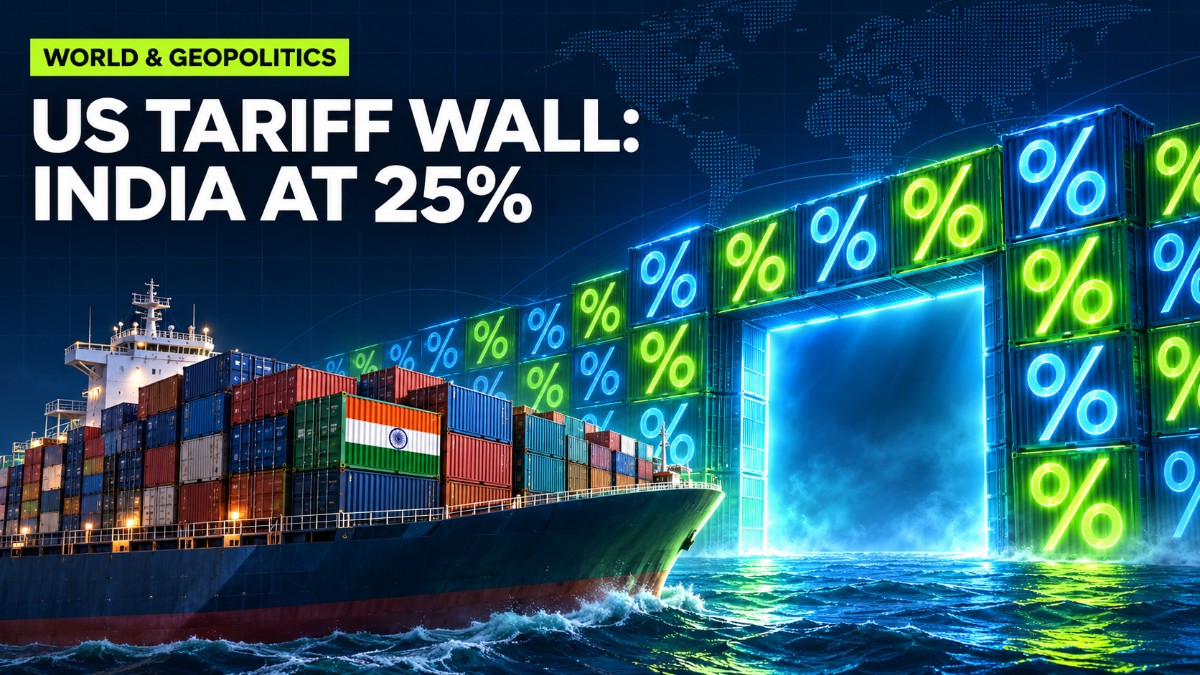
On 25 November, the United States did something that will shape trade conversations in India for months. Its trade office, the USTR, proposed new tariffs on 14 economies at once, and India is on the list. The proposed rate for Indian goods is up to 25%, falling to 17% if India signs a trade agreement Washington finds acceptable. Nothing is in force yet, but the clock has started.
For anyone preparing for an MBA, this is a textbook case of how trade policy, law and negotiation fit together. Here is what happened, why, and what it could mean.
What happened
The USTR announced findings in 14 investigations under Section 301 of the US Trade Act of 1974. The common charge is “structural excess capacity”: the claim that these economies produce far more manufactured goods than their own markets can absorb, and push the surplus onto world markets at low prices.
The 14 economies are China, the European Union, India, Japan, South Korea, Taiwan, Vietnam, Thailand, Malaysia, Indonesia, Singapore, Cambodia, Bangladesh and Switzerland. Two others that were investigated, Mexico and Norway, have not received decisions yet.
The proposed rates differ by country:
- India: up to 25%, or 17% with an acceptable trade agreement.
- Vietnam: up to 35%, or 20% with an agreement.
- Singapore: up to 20%, or 10% with an agreement.
- China: up to 20%, with a possible 40% if talks fail.
- EU, Japan, Korea, Taiwan, Switzerland: 15%, broadly in line with deals they have already struck.
- Bangladesh, Cambodia, Thailand, Malaysia, Indonesia: up to 18%.
Law firm Baker McKenzie notes that 12 of the 14 headline rates are at or below 20%. India’s 25% is one of the higher numbers, and that is the point: it works as leverage in a negotiation that is still open.
Why it happened
The story starts earlier this year. In February 2026, the US Supreme Court ruled that tariffs imposed under an emergency-powers law (IEEPA) were unlawful. That removed a big part of Washington’s tariff toolkit. Temporary tariffs followed under another provision, and in July the USTR used Section 301 to impose tariffs on 60 economies over forced-labour concerns.
The overcapacity cases are the second half of that rebuild. The investigations were launched on 11 March 2026, hearings were held in May, and the USTR received more than 1,070 written comments. Unlike emergency powers, Section 301 action rests on country-by-country investigations, with public comments and hearings built into the process.
For India specifically, the USTR points to industrial plans that expand manufacturing capacity, weak labour protections, “financial repression”, long-standing market access barriers, and investment and imports from non-market economies. The sectors it names are pharmaceuticals and medical devices, steel, solar equipment and information and communications technology.
The numbers and dates that matter
- 25% vs 17%: the eight-point gap is the price tag on a trade deal.
- 5 January 2027: deadline for written comments and requests to testify.
- 25 January 2027: public hearings begin in Washington.
- “Early 2027”: when Baker McKenzie expects final decisions. No effective date has been announced.
- 14–15 December 2026: the G20 leaders’ summit in Miami, where, according to Holland & Knight, a senior US official suggested some trade agreements could be finalised.
There are also important carve-outs. For India and 12 others (not China), goods already covered by separate US national-security tariffs under Section 232, such as steel, aluminium, copper, vehicles and parts, patented medicines and semiconductors, are excluded. So are some raw materials and goods the US cannot easily produce itself. India gets its own list of exempt products, so exporters must check the India notice line by line rather than assume.
How India has responded
India has rejected the excess-capacity charge from the start. When the probe was opened earlier this year, New Delhi pushed back and asked for the investigations to be closed. After this week’s announcement, All India Radio reported that the government is examining the notice while rejecting the core argument that India is responsible for global gluts. The stated preference is to settle differences through the bilateral trade talks already under way.
That is the real game. The US has set a high rate and a lower rate, and the gap between them invites India to close a deal. India, on the other hand, will argue that its manufacturing push serves a huge domestic market and is not built to flood the world.
What it means for India, students and careers
For exporters: companies selling to the US in the named sectors face months of uncertainty. Expect them to file comments, review pricing and look harder at Europe, the Gulf and other markets. Firms that assemble goods using parts from other covered countries will also need to track “country of origin” rules closely.
For policy: the case pushes India to balance two goals. “Make in India” and production-linked incentives aim to build manufacturing scale. Washington now labels similar policies as overcapacity. How India frames its industrial policy in trade talks will matter.
For students: this is a live example of concepts you meet in economics and strategy classes: tariffs as bargaining chips, legal risk in policy, supply-chain diversification (“China plus one”), and why firms hedge across markets. It also shows why trade, compliance and supply-chain roles are growing in importance inside Indian companies.
MBA interview angle: 3 questions you could be asked
- The US offers India 17% with a trade deal and 25% without. How would you approach that negotiation if you were on India’s side?
- Is “excess capacity” a fair charge against a fast-growing economy that is building factories for its own market? Argue both sides.
- If you ran an Indian pharma or solar exporter, what three steps would you take before January 2027?
FAQs
Are these tariffs already being collected?
No. They are proposals. Comments are due by 5 January 2027 and hearings begin on 25 January 2027. Final decisions are expected in early 2027.
What is Section 301?
It is a part of the US Trade Act of 1974 that lets the USTR investigate foreign practices it considers unfair and respond with tariffs or other measures. It was also used against China in 2018.
Will every Indian export be hit?
Not every product. Goods covered by separate US Section 232 tariffs (like steel, vehicles and patented medicines) and items on India’s exemption list are excluded. Everything else from India could face the new rate.
Sources
- USTR press release, 25 Nov 2026
- Baker McKenzie Global Import Blog
- Holland & Knight analysis
- All India Radio News
- Business Standard: India rejects US Section 301 probe